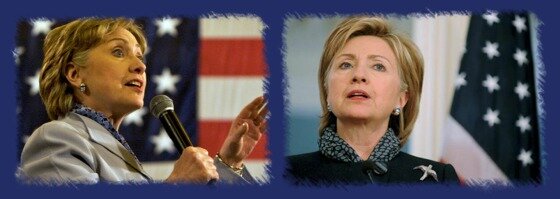
Keeping Up With Hillary Since 1992.
The Hillary Clinton Quarterly has been keeping up with Hillary's career since 1992 when she became First Lady. As Secretary of State, Hillary carries out the President's foreign policies through the State Department and the Foreign Service of the United States. She was sworn in as the 67th Secretary of State of the United States on January 21, 2009.
2012 Election Merchandise - CLICK HERE!

Custom Search
The Vast Right Wing Conspiracy: Hillary Clinton Strikes Back at Her Critics.
(Originally published in the Hillary Clinton Quarterly, Fall 1994)
Edited by Frank Marafiote
Evidently, we're not the only ones who have noticed an increase in the anti-Clinton invective (see Editor's Notebook). After enduring months of highly personal attacks against herself and her husband, First Lady Hillary Rodham Clinton lashed back at her most outspoken critics in a discussion of health care reform with reporters. The White House faxed HCQ a copy of her remarks. Here is a verbatim transcript of the highlights.
Reporter: You told Peter Maier that there are right-wing radical ideologues who don't want people to have health care in this country. Who are you talking about? Who are these folks?
Mrs. Clinton: Well, you know I think they are a combination of the same kind of people who have been around in our country since its beginnings, the sort of ideologically-opposed who think that nobody should get anything from anybody else. And there's a streak of that in American politics. There always has been.
There are people who opposed social security, opposed civil rights, opposed minimum wage, opposed Medicare, opposed Medicaid. I mean at every step along the way, there is this small core of people who do not believe that government should do anything. Now they're the same people who drive down highways paid for by government funds. They are the same people who love the Defense Department which is funded by government money, but they have a different mind set when it comes to social policy in trying to be a compassionate and caring nation.
Then there are the people who for opportunistic reasons are opposing health care reform both because it is in their financial interest to do so because they want to be able to maintain the status quo and they are not above inciting other people to be very emotional about helping them to sustain their favored position. And then there are those who are for political reasons opposing health care reform because there are lots of people who don't want any changes and particularly don't want changes by this President to occur.
Now, most of the people I've just described are ones who pull the strings of others and inflame people by making charges of socialized medicine, for example, or the government is going to take over the health care system. And there's a very well-organized and well-financed effort to convey that message so that, for example, when you see people protesting in the streets as we saw a couple of weeks ago, as I personally saw in Seattle, they were there in large measure because they'd been inflamed by a local radio talk show host who finds it in his own personal financial opportunistic interest to take this position. I had no idea whether the man was insured or not, but he inflames people who are sitting at home that somehow the Clintons are going to take over the government and they're going to find themselves without a doctor or whatever their arguments are.
And if you talk to these people very often they don't have a clue about what health care reform is about. They are responding to these emotional kinds of attacks. And I just think that's part and parcel of what you always find when you look at moments of a lot of change converging at the same point in American history. You will find that strain of people. And I think it's very unfortunate, but it's something that is part of our political scene.
What I do not like and what I find regrettable is the amount of hatred that is being conveyed and really injected into our political system. I don't have any problem with anybody disagreeing with this President on any policy position. I don't have a problem with any member of Congress opposing health care reform because he doesn't think it's a good idea or he wants to use it as a political weapon. I mean, that's politics.
But this personal, vicious hatred that for the time being is aimed primarily at the President, and to a lesser extent myself, I think is very dangerous for our political process. And I think those who are encouraging it should think long and hard about the consequences of such encouragement. And in a free society, certainly people are free to say or do what they think furthers their political agenda.
But we have to draw the line on violence, and you have to draw the line on protests that incite violence. And a lot of the talk that is coming out is, to me, very sad, and I think we'll have very unfortunate consequences for our entire body politic and not just for this Administration.
Reporter: Mrs. Clinton, you said earlier that the debate has heightened public understanding of the health care issues. But as we approach the elections the rhetoric is getting increasingly more partisan. Do you think that helps public understanding or just adds to some of the confusion?
Mrs. Clinton: I think that's a fair question because it has, in the last couple of weeks, gotten increasingly partisan and it's brought out all the old bromides. I see some of these signs that look like they've been around since Social Security, about socialism. And I don't think that's particularly beneficial for the substantive debate. But actually, it may be helpful in sharpening the differences, because when someone gets on TV as a member of the Congress and says health care reform which is meant to guarantee you private insurance is socialism, I think it's fair then to ask, well, you must be against Social Security and Medicare, right? Oh, no, that's different.
So I think that, in effect, the partisan rhetoric which is now filling the airwaves and the halls of Congress may help politically because it's so far-fetched. And I think that once that becomes clear to people, then we can go back to hammering out the substance of what needs to be done.
Reporter: You talk a lot about the power of special interests. And I don't want to prejudge the outcome of the debate at all, it seems like a toss-up to me, but should health care reform fail, what do you think that history will record as the reason? Have you been -- you talk a lot about special interests, have you been sobered at all -- discovered the American electorate is --
Mrs. Clinton: No, no. But I think it's just reinforced what is an unfortunate fact of life, which is that huge amounts of money spent to convey an intense negative message has a very powerful impact. We know that. It's one of the real unfortunate effects in our political life of negative advertising. And it is always easier to be against something than to be for something, particularly if being for something means you are for changes that affect a lot of people and which have a very broad constituency instead of a narrow focused constituency.
So nothing about this has been surprising. It's been right in line with what has always happened. I mean I saw a study that seemed to suggest that in 1947 or '48 the special interests -- largely at that time, organized medicine against Harry Truman's health care reform -- spent $60 million. Now $60 million in the late '40s was a whole lot of money.
And that was before commercial insurers took off; it was before a lot of the interests we're up against today that have a vested stake in how the system currently runs were very well established. So now the latest survey or the latest amount of money that has been guessed at having been spent against us in the whole campaign for health care reform and trying to get the message out to people is about $120 million. I think that's what the Annenberg Institute or somebody -- the Annenberg Institute which has followed the debate said their estimate was that $120 million had been spent against the idea of health care reform.
So when you've got that kind of money being spent when its message is very simple -- its message is, don't do it -- whereas the positive message ranges from physicians who are for universal coverage but concerned about a willing provider, to pharmaceuticals that are for universal coverage but are concerned about any impact on drug pricing, to community action groups that are for universal coverage but want a single-payer system.
I mean, you go down the line of everybody who's for health care reform, particularly defined as universal coverage, it's a very broad group of organizations and interests. They cannot possibly have the intensity that the negative forces have. That is just, I think, to be expected.
Reporter: You just said, and the President has said a lot, that every time you moved toward the Republicans, they step back. Well, there are actually a number of Democrats that have also been equally as unyielding, and some -- Senator Breaux, for example, has actually moved away from positions he held earlier, like the trigger mandate. What do you have to say for them? Does that frustrate you; does it anger you? Or why hasn't the Democratic Party been more united on this issue?
Mrs. Clinton: Oh, please, Hillary. (Laughter.) I mean, this is part of being a Democrat. (Laughter.) Think of where we were a year ago -- the budget would never pass, you'd never get a majority, the Democrats were deserting the President, it will never work, it will raise unemployment, it will destroy interest rates, and on and on and on and on.
Well, we got it done and, by golly, it worked. And we got it done with all Democrats. And actually, we don't need quite as many Democrats because Senator Jeffords understands health care reform, unlike many others. And in fact, his support for health care reform has increased, as I understand it, his ratings in Vermont by 20 points.
So we're going to have a hard-fought battle down to the very end with a small group of Democrats and all but one of the Republicans claiming the sky is falling and that all kinds of terrible things will happen. And then, eventually, we will get a vote that will be a majority vote for a decent bill.
Reporter: Will you get it done with all Democrats again?
Mrs. Clinton: No, we've got Senator Jeffords. (Laughter.)
Well, we didn't have him on the budget and, I mean, I don't think you should -- that's not insignificant. And I think that -- the thing about those who understand the issue -- and I cannot stress this enough because many of the opponents of health care reform get away with rhetoric. It's like Senator Gramm going on TV and saying, it's socialized medicine, socialized medicine. And because our TV culture is such that the idea of getting at the truth is to have one side say the sky is falling and the other side say no it's not, then at the end of 30 minutes they say, thank you very much. And nobody presses these guys to say, oh, really? And how is it that it's socialized medicine? What does that mean? Does that mean that private insurance is going to start telling Americans what doctors they can use? Does that mean Medicare, which is paid for by a payroll tax, which is certainly a mandate, is going to all of a sudden start telling my mother what doctor she can use?
Nobody ever presses these guys. They get away with it day in and day out. So my hope is that as the debate actually is joined, and people have to defend their positions in public over a sustained period of time, this will become clearer to the American public about what really is at stake in this debate. And I have a lot of confidence that the outcome is going to be positive. And if it's a 51 vote, fine. If we hadn't had a 51 vote on the budget, we would not have 4 million new jobs, in my view.
So these are the kinds of trade-offs you make in life. And if you are trying to stand for something, and you believe it's bigger than yourself and you think it's the right thing to do, you stand up and get counted, no matter what the opposition or the political flack might be.
Reporter: Do you want to comment on the press coverage, print and press coverage?
Mrs. Clinton: Oh, I think the print press has been terrific. (Laughter.) No, I'm serious. If this debate had been played out based on what most of you -- not all -- but the vast majority of you have written, we would be further along. And I really mean this. Most of you have really gotten into the issue; you have studied it. What you've written has been clear and understandable to people. You've covered all sides of it, you've asked the hard questions.
And again, that's the difference between 1994 and 1934. I mean, it is not thoughtful print journalism, unfortunately, in many respects which drives these social policy debates. It is the 30-second ad; it is the very well organized direct mail campaign; it is the radio talk show network. So I wish that all this debate were played out on the basis of what the majority of you have written, because I think you've done a real service.
Embark on a rewarding online casino journey.

News
